

Perimenopause, Menopause & The Bigger Picture - Why Hormones May Not Be the Whole Story

By Julie Smullen FNC CGP CGC
We are hearing more conversations than ever about ADHD, anxiety, burnout, osteoporosis, brain fog, hormone therapy, and perimenopause.
But what if many of these conversations are more connected than we realise?
What if we have been focusing on individual symptoms while missing the bigger picture underneath?
We are talking more than ever about hormones. But perhaps we're not talking enough about the terrain those hormones depend on.
Most conversations focus on hormones in isolation. Far fewer conversations explore the role of mineral status, toxic burden, thyroid function, cellular energy production, bone health, and the body's ability to produce and respond to hormones effectively.
Yet these systems are deeply interconnected and influence how a woman experiences the transition into perimenopause and menopause.
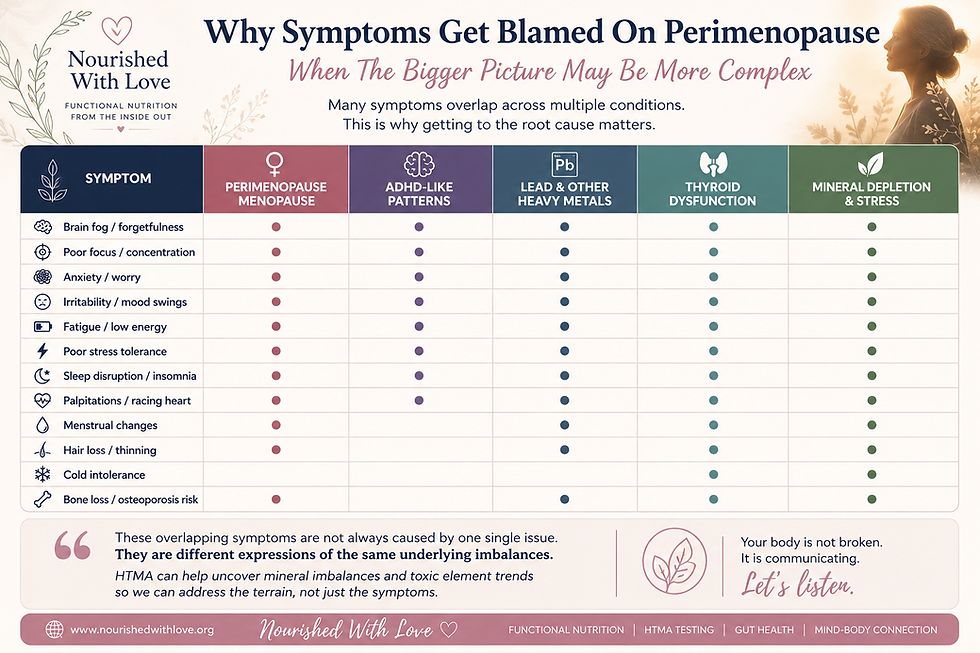
Many symptoms commonly blamed on perimenopause overlap with mineral imbalances, thyroid dysfunction, toxic burden and ADHD-like patterns. This is why understanding the terrain matters.
More women than ever are talking about brain fog, anxiety, burnout, ADHD, poor resilience, osteoporosis, and feeling unlike themselves.
Not just hot flushes or changing cycles… but a deeper feeling that their body, brain, and nervous system have changed almost overnight.
Women who once handled stress, busy schedules, careers, children, exercise, social lives, and constant pressure suddenly feel like they can barely keep up.
Sleep changes. Anxiety appears out of nowhere. Brain fog becomes relentless.
Tolerance for caffeine, alcohol, stress, supplements, busy environments, or even noise completely shifts.
Many women describe feeling:
“not like themselves anymore.”
At the same time, we are seeing more conversations than ever around ADHD in women, burnout, anxiety, nervous system dysregulation, osteoporosis, DEXA scans, hormone therapy, perimenopause, exhaustion, and “normal blood tests.”
And honestly, I think women are beginning to realise there is a deeper story underneath all of this.
Because many women know something has changed long before standard testing shows anything significant.
As a Functional Nutrition Consultant and Certified GAPS Practitioner, I’ve become increasingly interested in this area because I see so many women struggling while still searching for answers.
And I believe we need to start looking beyond hormones alone.
Because hormones do not work in isolation.
Women Are Not Suddenly “Breaking”
One of the biggest things I hear from women is:
“I used to cope… and now I can’t.”
That sentence says everything.
Because for many women, this is the stage where resilience suddenly seems to disappear.
Stress that once felt manageable suddenly feels overwhelming.
Sleep becomes lighter and less restorative.
Anxiety increases.
Emotions become harder to regulate.
Focus worsens.
Even women who have spent years “pushing through” suddenly feel like their body has hit a wall.
And while hormones absolutely matter, I don’t believe this conversation should stop at:
“You need more estrogen.”
Because the body is biochemical.
Hormones rely on minerals, thyroid function, adrenal health, mitochondrial energy production, nervous system regulation, detoxification pathways, blood sugar stability, and nutrient status to function properly.
Which means sometimes the issue is not simply declining hormones.
Sometimes the body no longer has the resources required to adapt well to those hormonal changes.
Could Perimenopause Be Revealing What Was Already There?
One of the most fascinating things about perimenopause is that it doesn't necessarily create problems from scratch.
Instead, it often exposes underlying weaknesses that the body has been compensating for, sometimes for decades.
A woman may have managed years of chronic stress, nutrient depletion, poor sleep, blood sugar instability, environmental exposures, nervous system overload, and inflammatory load without obvious symptoms.
Then perimenopause arrives and suddenly the body can no longer compensate in the same way. This is one reason why many women describe feeling like they have changed overnight.
Perhaps the question isn't simply:
“What hormone is missing?”
Perhaps we should also be asking:
“What has the body been compensating for all these years?”
The Body Cannot Run A Hormone Factory Without The Raw Materials
One of the biggest misconceptions in women's health is that hormones operate independently.
They don't.
Hormone production is incredibly energy intensive. The ovaries, adrenal glands, thyroid, mitochondria, liver, nervous system, and detoxification pathways all require nutrients and minerals to function properly.
Hormone production is essentially a biochemical assembly line.
If the minerals, enzymes, cellular energy, and cofactors required for that pathway are missing, the assembly line becomes less efficient regardless of how much focus is placed on the hormones themselves.
This is one reason why two women with similar hormone levels can experience vastly different symptoms.
Without adequate mineral reserves, the machinery becomes less efficient. The conversation then becomes much bigger than estrogen alone.
Minerals such as magnesium, zinc, selenium, iron, manganese, calcium, and copper all play important roles in hormone production, thyroid function, nervous system regulation, mitochondrial energy, cellular repair, stress resilience, and detoxification.
This is one reason why some women feel exhausted no matter what they try, stop responding well to generic protocols, feel worse from random supplements, or continue struggling despite “normal” hormone levels.
The body cannot create resilience out of nothing.
And when women have spent years under chronic stress, poor sleep, under-eating, overtraining, blood sugar instability, gut dysfunction, inflammation, or environmental exposures, the transition into perimenopause may become much harder.
The Heavy Metal Conversation Women Deserve to Hear About!
This is one of the most fascinating, and overlooked, parts of the entire conversation.
Bone is not simply structural tissue. Bone also acts as a storage site for minerals and toxic elements accumulated over decades.
Many women are now hearing more discussions around osteoporosis, bone density, DEXA scans, estrogen decline, and bone loss during menopause. But very few are hearing about the biochemical connections underneath this process. Lead, for example, is stored in bone tissue.
As estrogen changes and bone remodelling increases during perimenopause and menopause, researchers have observed that stored lead can be redistributed back into circulation.
This means some women may become more biochemically vulnerable during this stage of life even if the exposure happened years earlier.
And when you start connecting the dots, the bigger picture becomes incredibly interesting.
Because lead and other heavy metals affect dopamine pathways, cognition, mood, nervous system regulation, mitochondrial function, thyroid function, oxidative stress, and cellular energy production.
At the exact same time women are suddenly experiencing overwhelm, anxiety, ADHD-like symptoms, poor focus, emotional dysregulation, exhaustion, nervous system sensitivity, brain fog, and poor resilience.
This does not mean heavy metals are the sole cause of perimenopause symptoms.
But it absolutely raises an important question:
Are women simply “hormone deficient”… or are multiple biological systems colliding during this stage of life?
Personally, I believe this is a conversation women deserve to hear more about.
Why The ADHD & Perimenopause Conversation Is Exploding?
There is a reason this topic is suddenly everywhere.
Women are being diagnosed with ADHD in their 40s and 50s at unprecedented rates.
And honestly, when you understand the physiology, it starts making far more sense.
Estrogen directly influences dopamine signalling.
Research has identified associations between lead exposure and an increased risk of ADHD and ADHD-like symptoms, particularly through its effects on brain development, cognition, attention, executive function, and dopamine signalling.
At the same time, changing hormone levels influence bone turnover, and bone stores lead accumulated over a lifetime.
When you step back and look at the bigger picture, it becomes easier to understand why so many women are suddenly experiencing poor focus, overwhelm, emotional dysregulation, anxiety, brain fog, and ADHD-like symptoms during perimenopause.
This does not mean heavy metals cause ADHD.
However, it highlights how interconnected hormones, minerals, bone health, toxic burden, the nervous system, and cognitive function truly are.
Many women are not simply dealing with “one thing.”
They are dealing with years of accumulated stress, mineral depletion, environmental exposures, nervous system strain, changing hormonal physiology, and the body's reduced ability to compensate for those pressures.
Perhaps this is why so many women suddenly find themselves asking:
"What happened to me?"
The better question may be:
"What has my body been trying to compensate for all these years?"
Lead receives particular attention because of its well-established effects on cognition, attention, executive function, and dopamine signalling.
However, lead is not the only toxic element that can influence how we feel.
Research has also explored the effects of mercury, cadmium, arsenic and other toxic elements on neurological function, thyroid health, mitochondrial energy production, hormone metabolism and overall health.
The impact of these elements is rarely isolated. It is often the cumulative burden, combined with mineral deficiencies, chronic stress, inflammation and other physiological stressors, that influences how the body functions.
The Osteoporosis Conversation May Be Bigger Than Bone Density Alone
There has never been more discussion around osteoporosis, bone density, and DEXA scanning than there is today.
And that's important.
But perhaps we should also be asking a bigger question:
Why are so many women becoming more vulnerable during this stage of life?
Bone is often viewed simply as a structural tissue, but it is actually a living, metabolically active organ that acts as a storage site for both essential minerals and toxic elements accumulated throughout life.
One of the most fascinating areas of emerging research is the relationship between bone health and toxic burden.
Approximately 90–95% of the body's lead burden is stored within the skeleton. Bone acts as a long-term storage site for lead accumulated throughout life from environmental exposures.
As estrogen changes during perimenopause and menopause, bone remodelling and bone turnover increase. This not only affects bone density but may also influence the movement of minerals and previously stored toxic elements throughout the body.
Researchers have become increasingly interested in how this process may influence the redistribution of stored lead and its potential effects on cognitive function, cardiovascular health, metabolic health, and overall wellbeing.
This is particularly interesting given the growing public focus on osteoporosis, bone density testing (DEXA scans), cognitive health, ADHD symptoms, and healthy ageing in women.
Researchers are also increasingly investigating the relationship between toxic metals, mineral status, ovarian ageing, mitochondrial function, and bone health.
Perhaps osteoporosis, hormonal symptoms, anxiety, ADHD-like symptoms, brain fog, poor resilience, and nervous system changes should not always be viewed as completely separate conversations.
Perhaps they are different expressions of the same underlying biological story.
Endometriosis, Gut Health & The Bigger Picture
We are also seeing increasing rates of endometriosis and other estrogen-related conditions.
While endometriosis is a complex condition with multiple contributing factors, researchers continue to investigate the roles of inflammation, gut health, estrogen metabolism, immune function, environmental exposures, and the microbiome.
The gut plays an important role in hormone metabolism, and disturbances within the microbiome may influence how hormones are processed and recycled within the body.
This is yet another reminder that hormones do not operate in isolation.
The body is an interconnected system where gut health, mineral status, detoxification pathways, immune function, nervous system regulation, and hormone signalling all influence one another.
Why “Normal” Blood Tests Often Don’t Match How Women Feel
This is one of the biggest frustrations women are experiencing.
Because many women know deep down something is wrong while repeatedly being told:
“Everything looks normal.”
Part of the reason is because standard hormone testing measures circulating hormones in the bloodstream.
It tells us very little about mineral status, adrenal patterns, nervous system resilience, mitochondrial function, tissue-level hormone activity, toxic element burden, or how efficiently the body is actually functioning at a cellular level.
And this is why so many women continue feeling awful despite trying supplements, hormone protocols, restrictive diets, adrenal products, and “hormone balancing” supplements without truly understanding what is happening underneath.
What If We've Been Looking at the Symptoms Instead of The Pattern?
ADHD.
Anxiety.
Burnout.
Perimenopause.
Brain fog.
Osteoporosis.
Poor resilience.
Fatigue.
Hormone imbalance.
While these may appear to be separate conversations, many share common underlying themes involving mineral depletion, mitochondrial dysfunction, toxic burden, nervous system stress, thyroid function, blood sugar regulation, and hormone signalling.
Perhaps the real question isn't:
“Which label do I have?”
Perhaps the better question is:
“What is my body trying to tell me?”
Why I Find HTMA So Valuable
Hair Tissue Mineral Analysis (HTMA) is one of the tools I use to help look at the bigger picture.
It is a non-invasive test that looks at mineral patterns and toxic element trends at a tissue level.
Rather than focusing on one isolated marker, HTMA helps assess the terrain underneath the symptoms.
It provides insight into mineral imbalances, stress patterns, adrenal patterns, nervous system patterns, metabolic trends, and toxic element accumulation patterns.
Importantly, HTMA does not diagnose menopause, ADHD, thyroid disease, or heavy metal toxicity.
Instead, it helps provide a broader functional picture that can be considered alongside symptoms, history, and other testing.
And for many women, finally seeing those deeper patterns can feel incredibly validating.
Why I Don’t Believe in Random Supplementation
This is something I feel strongly about.
So many women are desperately trying to feel better and end up taking handfuls of supplements without ever understanding their mineral balance first.
Many women are also told to simply take iron without looking deeper at iron regulation, copper balance, inflammation, thyroid function, or whether the body is actually utilising iron properly.
This is one reason I personally prefer a food-first approach alongside carefully selected bioavailable supplementation where appropriate and individualised.
Because every woman’s terrain is different.
Gut Health Matters Too
As a Certified GAPS Practitioner, I believe we cannot ignore the role of digestion, nutrient absorption, blood sugar balance, inflammation, gut health, and nervous system regulation because the body cannot build hormones properly without the raw materials required to do so.
But I also understand many women already feel overwhelmed.
This is why I focus on practical, sustainable support rather than rigid perfection.
Sometimes the goal is simply helping the body feel calmer, safer, nourished, and more resilient again.
Your Body May Be Struggling, Not Failing
I think this is something many women desperately need to hear.
You are not weak.
You are not lazy.
You are not “crazy.”
And you are not failing because you suddenly cannot cope the way you used to.
Many women today are carrying years of chronic stress, depletion, nervous system overload, poor sleep, blood sugar instability, under-eating, overtraining, inflammation, and environmental exposures while still trying to function at full capacity every single day.
Perimenopause may simply be the point where the body can no longer compensate as effectively.
And instead of only asking:
“What hormone are we missing?”
maybe we should also be asking:
“What does the body need in order to function properly again?”
If You Feel Like Your Body Has Changed Overnight…
If you are struggling with fatigue, anxiety, overwhelm, poor stress tolerance, brain fog, sleep disruption, hormonal symptoms, hair loss, worsening resilience, or simply feeling unlike yourself, it may be time to look deeper than hormones alone.
HTMA may help uncover mineral patterns, stress patterns, and toxic element trends that could be contributing to how you feel and help guide a more personalised support plan.
Because sometimes the missing piece isn’t just hormones.
Sometimes it’s the terrain underneath them.
Why Supplementation Isn't Always the Answer
One of the biggest mistakes I see is women trying supplement after supplement without understanding what their body actually needs.
Iron is a perfect example.
Many women assume they need iron because they feel tired, experience hair loss, struggle with concentration, or have heavy periods. Yet iron is only one piece of a much larger picture.
Iron metabolism depends on many other nutrients, including copper, zinc, vitamin A, magnesium, protein status, thyroid function and gut health. Taking iron without understanding the wider picture can sometimes worsen existing imbalances.
The same applies to zinc, magnesium, iodine, selenium and many other nutrients.
The goal isn't simply to take more supplements.
The goal is to understand:
What minerals are deficient?
What minerals are excessive?
Are heavy metals interfering with normal function?
Is thyroid function contributing?
Is adrenal stress contributing?
Are minerals actually reaching the cells where they are needed?
This is one reason I value HTMA so highly.
Where Does SmartDNA Fit into This?
Many people know that I also offer SmartDNA testing, and it can be an incredibly valuable tool when used alongside HTMA.
SmartDNA looks at your genetic blueprint and helps identify tendencies in areas such as:
Detoxification pathways
Hormone metabolism
Methylation
Histamine processing
Stress response
Inflammation
Nutrient requirements
Brain health and neurotransmitter function
It helps answer the question:
"What is my body genetically predisposed to?"
HTMA helps answer a different question:
"What is happening right now?"
For example, SmartDNA may show that you have a greater need for zinc, magnesium, selenium, or support for detoxification pathways. HTMA can then show whether those minerals are currently depleted, whether heavy metals are present, and how those imbalances may be affecting your health today.
This is why I often recommend starting with HTMA.
It provides a practical snapshot of your current mineral balance and toxic element burden and can help identify areas that may be contributing to symptoms right now.
If we need to dig deeper, SmartDNA can then provide another layer of information, helping us understand why certain patterns may be occurring and how your body is designed to function best.
Together they can provide a much more complete picture than either test alone.
I offer HTMA testing and interpretation, Functional Nutrition support, GAPS Protocol, SmartDNA interpretation, personalised mineral and nutritional guidance, practical food-first strategies, and bioavailable supplementation support where appropriate.
You deserve more than being told:
“Everything looks normal.”
You deserve to understand your body.
And you deserve to feel like yourself again.
Ready To Understand What Your Body Is Telling You?
If you're tired of guessing, tired of trying supplement after supplement, and tired of being told everything looks normal despite not feeling like yourself, it may be time to look deeper.
HTMA can provide valuable insight into your mineral balance, stress patterns, and toxic element trends, helping us build a clearer picture of what may be contributing to your symptoms.
As a Functional Nutrition Consultant, Certified GAPS Practitioner, and SmartDNA Practitioner, my goal is not simply to chase symptoms.
My goal is to help you better understand the terrain underneath them, because sometimes the missing piece isn't another supplement.
Sometimes it's understanding what your body has been trying to tell you all along.
Learn More About HTMA & Bookings:
Disclaimer: This article is intended for educational purposes only and is not intended to diagnose, treat, cure, or prevent any disease. The information presented is based on a combination of scientific literature, practitioner education, and clinical observations. HTMA is not a diagnostic tool and should be interpreted alongside a person's symptoms, history, and other relevant investigations.
References
Menopause, Perimenopause & Women's Health
Avis NE, Crawford SL, Greendale G, et al. Study of Women's Health Across the Nation (SWAN): A Multisite, Multiethnic Investigation of Women During the Menopause Transition. University of Michigan.
Maki PM, Kornstein SG, Joffe H, et al. Guidelines for the Evaluation and Treatment of Perimenopausal Depression: Summary and Recommendations. Menopause. 2018;25(10):1069–1085.
Weber MT, Maki PM, McDermott MP. Cognition and Mood in Perimenopause: A Systematic Review and Meta-Analysis. Journal of Steroid Biochemistry and Molecular Biology. 2014;142:90–98.
Bone Health, Lead Storage & Toxic Metals
Silbergeld EK, Schwartz J, Mahaffey KR. Lead and Osteoporosis: Mobilization of Lead from Bone in Postmenopausal Women. Environmental Research. 1988;47(1):79–94.
Gulson BL, Mizon KJ, Korsch MJ, Palmer JM, Donnelly JB. Mobilization of Lead from Human Bone Tissue During Pregnancy and Lactation: A Summary of Long-Term Research. Science of the Total Environment. 2003;303(1–2):79–104.
Nash D, Magder L, Lustberg M, et al. Blood Lead, Blood Pressure and Hypertension in Perimenopausal and Postmenopausal Women. JAMA. 2003;289(12):1523–1532.
World Health Organization (WHO). Lead Poisoning and Health. Geneva: World Health Organization.
Agency for Toxic Substances and Disease Registry (ATSDR). Toxicological Profile for Lead. U.S. Department of Health and Human Services.
ADHD, Dopamine & Cognitive Function
Haimov-Kochman R, Berger I. Attention Deficit Hyperactivity Disorder and the Menopause Transition: Emerging Perspectives on Hormonal Influences and Cognitive Function. Maturitas.
Nadeau KG, Littman E, Quinn P. Understanding Women with ADHD. Advantage Books.
Minerals, Mitochondria & Nutritional Biochemistry
Ames BN. Low Micronutrient Intake May Accelerate the Degenerative Diseases of Aging Through Allocation of Scarce Micronutrients by Triage. Proceedings of the National Academy of Sciences. 2006;103(47):17589–17594.
Gröber U, Schmidt J, Kisters K. Magnesium in Prevention and Therapy. Nutrients. 2015;7(9):8199–8226.
Gropper SS, Smith JL. Advanced Nutrition and Human Metabolism. Cengage Learning.
Gut Health, Estrogen Metabolism & Endometriosis
Chadchan SB, Cheng M, Parnell LA, et al. Gut Microbiota and Endometriosis. Human Reproduction Update. 2022.
Kwa M, Plottel CS, Blaser MJ, Adams S. The Intestinal Microbiome and Estrogen Receptor-Positive Female Health Conditions. Journal of the National Cancer Institute. 2016.
Hair Tissue Mineral Analysis & Practitioner Resources
Watts DL. Trace Elements and Other Essential Nutrients: Clinical Application of Hair Tissue Mineral Analysis. Trace Elements Inc.
Watts DL. The Nutritional Relationships of Copper. Journal of Orthomolecular Medicine.
InterClinical Laboratories. Hair Tissue Mineral Analysis Clinical Reference Manual.
InterClinical Laboratories. Practitioner Education Resources: Women, Hormones, Minerals and Toxic Elements.
InterClinical Laboratories. HTMA Practitioner Training Materials.
Additional Educational Resources
Campbell-McBride, N. (2010). Gut and Psychology Syndrome: Natural Treatment for Autism, ADHD, Dyslexia, Dyspraxia, Depression and Schizophrenia. Medinform Publishing.
Campbell-McBride, N. (2020). Gut and Physiology Syndrome: The Nutritional Protocol for Autoimmune Disease, Neurological Disorders, Digestive Disorders, Allergies, Asthma and More. Medinform Publishing.


Comments